What should a healthy day look like for your child?

What does a healthy day look like?

Healthy Sleep | Healthy Teeth | Healthy Eating and Drinking | Healthy Play and Exercise

Sleep is especially important for children as it directly impacts mental and physical development, learning and growth. By the age of two, most children have spent more time asleep than awake and overall, a child will spend 40% of his or her childhood asleep!

  • Develop regular daytime and bedtime schedules that works for you and your child(ren)
    • Active children are sleepy children
  • Create a consistent and enjoyable bedtime routine that works for you
    • Avoid watching television before bedtime
    • The majority of children fall asleep in 45minutes
  • Establish a regular "sleep friendly" environment
    • Calm, comfortable, cool and dark with no television or screens
  • Encourage baby to fall asleep independently
    • Set limits that are consistent, communicated and enforced
    • Encourage use of a security object such as a blanket or stuffed animal

Toddlers need about 11-14 hours of sleep in a 24-hour period. When they reach about 18 months of age their naptimes will decrease to once a day lasting about one to three hours.

A poor diet can affect your baby's teeth. Begin to brush baby's teeth twice a day every day as soon as they appear. Use a smear of toothpaste (up to 3 years) or a pea sized amount (3-6 year olds). You should contact your dentist for a check-up as soon as the first tooth appears. 

Children aged 0-6 should use a toothpaste containing at least 1,000ppm fluoride. Those at higher risk of tooth decay should use a toothpaste containing 1350-1500ppm fluoride. Children aged 7 and over should use a toothpaste containing 1350-1500ppm fluoride.

Tooth decay is totally preventable.

Tips for healthy teeth:

  • Don't offer your baby foods or drinks high in sugar
  • Don't offer anything except milk or water in your baby's bottle
  • Don't let your baby or toddler take a bottle of milk to bed and fall asleep with milk pooling round their teeth
  • Don't dip dummies in anything sweet, or pacify children with sweet foods
  • Do introduce a cup from six months
  • To get your baby used to it, do start taking them to the dentist as soon as their teeth appear

For the complete Oral Health section please click here.

Download the brush DJ app, click here

Preventing and managing weight problems isn't just about diet - it is also about behaviour around eating. Children - especially toddlers - need clear boundaries. Don't let all those good eating habits disappear as your baby gets older. These are some tips for enjoying food and preventing problems:

  • Make mealtimes a family and social event. Sit together at a table and turn off the TV. This also encourages slower eating which in turn reduces the volume we eat. We all tend to eat more when distracted by a screen
  • As they begin to finger feed and use a spoon let your baby feed themself - they are pretty good at regulating what they need whereas we tend to keep encouraging more. At mealtimes allow older children to serve themselves
  • Set boundaries about eating - children often demand food or insist they are hungry when you know they have had enough to eat. They are often bored and/or thirsty
  • Don't let your older children get into the habit of helping themselves to food from the cupboards or fridge between meals - again, this is often a sign of boredom and the calories soon add up. Make sure they always ask and if you think they have had enough to eat or there is a meal coming up, do not allow it
  • Remember that being hungry is normal as a mealtime approaches - otherwise we would have no appetite. Children need to learn to wait
  • Do not worry if your toddler refuses something to eat - adults create fussy children because we tend to over interpret likes and dislikes. In fact, children cannot make real choices before they reach 4 to 5 years. Offer them what you expect them to eat with obvious allowances. If they choose not to eat it do not be tempted to offer something else - they will eat when they are hungry
  • Try to avoid drinks laden with sugar - this includes pure fruit juice. These are also not good for teeth! Tooth decay is totally preventable
  • Try not to reward with food and do not let others either. If grandparents want to offer treats suggest sticker books, reading books or an outing instead

Click here to download the Healthy Infant Feeding Booklet where this information was extracted from.

It's just as important to make sure the lunchbox your child takes to nursery or preschool provides a healthy and balanced lunch. This means plenty of good quality foods from the 5 food groups, with few 'processed' or packaged or ready-made foods (as these usually contains fewer good nutrients and often more salt and sugar).

A balanced packed lunch should contain:

  • starchy foods – these are cereals, bread, rice, potatoes, pasta. Starchy foods are a good source of energy and should make up a third of the lunchbox
  • protein foods – including meat, fish, eggs, lentils, chickpeas, beans, nuts, seeds and tofu/quorn
  • a dairy item – this could be cheese, a yoghurt or milk as a drink
  • vegetables, raw and/or cooked
  • a portion of fruit
  • water or milk to drink

Children often like food they can eat with their fingers, so chop up raw veggies such as carrots or peppers and give them hummus or cottage cheese to dip the veggies in. Breadsticks and wholemeal crackers are great finger foods that can be paired with cheese pieces.

Replace chocolate bars and cakes with fresh fruit. Vary the fruit each day and get them to try new things, such as kiwi or melon. You could also make up a tasty fruit salad. Be inventive and encourage your children when they try something new.

Note that dried fruit is no longer recommended as a between meal snack as it's high in sugar, and can be bad for teeth.

How much sugar should children be eating?

  • Children aged under 4 no more than 12g or 4 teaspoons of free sugars per day
  • Children aged 4 to 6 should have no more than 19g or 5 teaspoons of free sugars per day
  • Children aged 7 to 10 should have no more than 24g or 6 teaspoons of free sugars per day
  • Children aged 11 years and upwards, as well as adults, should have no more than 30g or 7 teaspoons of free sugar per day

An example of the sugar content of common lunchbox items includes:

  • A petit filous fromage fraise (80g) contains 2.5 teaspoons of free sugar
  • Barney bear cake bar (chocolate) contains 2 teaspoons of free sugar
  • No added sugar fruit shoot drink (apple and blackcurrant) contains 1 teaspoon of free sugar

This calculated together is 5.5 teaspoons of sugar in a standard lunchbox, meaning in one meal, a child under 4yrs, will have exceeded their daily intake by 1.5 teaspoons.

Click here for more information from Change4Life

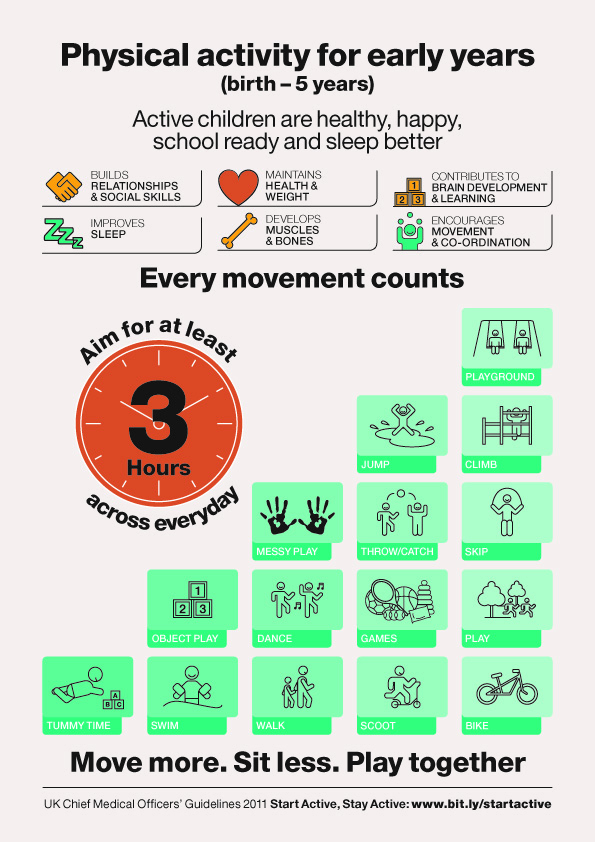
Toddlers learn eagerly and most want to try new activities. Encouraging your toddler to keep physically active will help him/her to:

  • Develop movement skills
  • Keep up with friends in the playground and in sporting activities as they get older
  • Stay a healthy weight
  • Keep a healthy heart

All activities such as active play inside or outside, walking, running and dancing counts.

If at all possible try and limit TV and other screen time like computers to just one hour a day.

Be patient; some toddlers take longer than others to learn new skills. Some are better co-ordinated than others. Keep gently encouraging, make it fun and give lots of praise.

Messy play: Getting used to putting their hands in different textures can help toddlers who are fussy about their food.

Pretend play: When toddlers play with toys and other objects and pretend they are people, they are learning about the world around them.

Fun activities for indoors or outdoors

  • Play 'keep it up' with a balloon
  • Have a dance-a-thon
  • Play catch with a bean bag
  • Plan an in/outdoor treasure hunt
  • Play musical statues
  • Play hide and seek
  • Read stories and sing songs that require actions in time with the words
  • Dance or jump to music
  • Make a den

Physically active toddlers should be in a safe environment and supervised at all times.

For more information on physical activity for children under 5yrs, click here


There are many sensory issues associated with sleep including:

  • Sensitivity to sound, touch, and visual stimuli which can be distracting and distressing and can affect the process of falling asleep.
  • Interoception difficulties, particularly recognising when hungry, full or thirsty or when the person is tired. 
  • Some children are more sensitive to foods like sugar, caffeine and additives which keep people awake.

Look at the bedroom environment to see what may be affecting their ability to go to sleep and stay asleep. Do their pyjamas and bedclothes feel comfortable, are they too hot or cold?  Is it too light or too dark, too noisy or too quiet? Perhaps it is too cluttered and stimulating. Think about your child’s diet. Are they eating too early or not having enough to eat? Are they eating food that can stimulate them close to bedtime. There can be added difficulties where children have restrictive diets but some simple adjustments of what is eaten and when can make a big difference. 

Click here for more information on sensory issues.
 

Sticking to the same routine helps your child to know what to expect at bedtime and helps them feel secure. It also helps to support your child’s internal body clock and keep it on track. The age related sleep advice and information on this website can help with establishing routines. Some children will benefit from using picture timetables, timers or social stories to help them understand their bed-time routine. More information about visual supports can be found on these websites

Visual Resources | Autism West Midlands 
Visual Supports | Autism Toolbox Autism Toolbox

Your child may be feeling overstimulated after a busy day and needs help to wind down, or their environment may be overstimulating with lots of toys, TVs and computers within reach. Avoiding TV and computers or hand-held devices an hour before bedtime can help your child to wind down. Activities that are good for the wind down period are jigsaws and colouring. Having a relaxing bath and milky drink can help some children, but for some children having a bath can over-excite them so they may need to have their bath earlier in the day.

Children who wake to use the toilet, wet the bed, or who wear nappies or pull-ups at night that need changing may have disturbed sleep. Eric, the children’s bowel and bladder charity are a good source of advice on this topic.


What might help 

Keeping a sleep diary 

A sleep diary can help you understand what may be causing difficulties with sleep. Fill it out every evening and record as much as you can. You can use it to spot patterns and make changes that may help. 

The Sleep Charity have templates you can download; one for teenagers and one for younger children. 

Seeking advice and help from sleep services 

There are organisations that can help you if you are having difficulties with your child’s sleep. There are many national organisations, including those who specialise in sleep for SEND families, and there are also community-based services in Shropshire, Telford and Wrekin. Click the link at the bottom of page to visit our support services page. 

Understanding sleep cycles 

The circadian sleep cycle is a 24-hour cycle that helps govern essential bodily functions especially the sleep-wake cycle. It plays a vital role in a person’s ability to sleep in one consolidated block of time at night and to stay awake during the day. As the sun sets in the evening, the brain begins producing melatonin, a hormone that induces sleepiness. Core body temperature also drops.

As melatonin and tryptophan (an amino acid which helps produce melatonin) are naturally produced in the body, there are things you can do to help their production.  Darkness helps to promote the production of melatonin which is why it is a good idea to put your child to sleep in a darkened room, and light emitting devices such as tablets and phones also can destroy Melatonin so should not be used for at least an hour before bed. New research shows that limiting exposure to screens and increasing physical activity levels during the day has a positive effect on children's overall physical, mental health and wellbeing, including sleep.

Setting a waking time consistently even in holiday times, called ‘anchoring’ the wake time, can help to reset the body clock over time. This should be accompanied with exposure to lots of light on waking to support circadian rhythm. 

Melatonin and tryptophan occur naturally in some foods and drinks such as milky drinks and cereals which is why having a milky drink before bed can help settling to sleep. For more information visit Diet & Sleep - The Sleep Charity

Prescriptions of melatonin

Behavioural strategies and practical solutions are the best way to address sleep difficulties, but if they are having a significant impact on your child’s ability to function, a drug form of melatonin is sometimes prescribed for neurodivergent children. As the drug’s function is to re-set sleep and wake cycles, it works best combined with good sleep hygiene practices. It is important that is it taken under medical supervision and not purchased on-line so that it is closely monitored for dosage and side effects. It should be prescribed for the shortest period necessary as the long-term effects of the drug on children’s development are not yet known. 
In Shropshire, Telford and Wrekin the Community Paediatric Service and the BeeU Service (CAMHS) can prescribe Melatonin for children and young people who meet ALL of the following criteria.

  1. the child/young person must be open to and being treated by the service due to a neurodevelopmental/mental health need (diagnosis not required)
  2. sleep issues are causing significant impact on the child/ young person, for example due to daytime sleeping or behavioural problems that are impacting daily functioning or educational attendance
  3. behavioural approaches have been tried and failed. These may have been offered by the service (where available) or by community sleep support services.

GPs are unable to prescribe Melatonin although they sometimes issue repeat prescriptions when prescribing has been started by a specialist (such as a paediatrician or child psychiatrist). 

Further support 

Click on the link below to visit a page with information about

  • national websites and sleep organisations
  • local community services in Shropshire, Telford and Wrekin.