


Acute exacerbation of asthma

Advice for professionals

What is an acute exacerbation of asthma?

A worsening of your child’s asthma caused by exposure to one of their triggers. These vary between children but the most common ones are coughs and colds, cold weather, cigarette smoke, pet fur or feathers and pollen.

Asthma Action Plan

Keep this plan with you and take it every time you see the doctor or nurse at your GP surgery (or Hospital). This plan is for patients with asthma – your GP/doctor (or nurse) will fill it in and explain the different medicines to control your asthma. It will also show you how to recognise when the asthma or wheeze is getting worse and what to do about it. By taking steps early – acute attacks can usually be prevented.

Paediatric Pathway

Click here to view the acute asthma paediatric pathway. 
When should you worry?

If your child is:

  • Too breathless to talk / eat or drink
  • Has blue lips
  • Having symptoms of cough/wheeze or breathlessness which are getting worse despite 10 puffs blue (salbutamol) inhaler every 4 hours
  • Confused and drowsy

Ring 999 for immediate help

Give 10 puffs of blue (salbutamol) reliever inhaler every 10 minutes until ambulance arrives

Keep child in upright position and reassure them

If your child is:

  • Wheezing and breathless and blue (salbutamol) reliever inhaler 2-5 puffs is not lasting 4 hours
  • Having a cough or wheeze/tight chest during the day and night
  • Too breathless to run / play / do normal activities

Immediately contact your GP and make an appointment for your child to be seen that day face to face

Increase blue (salbutamol) reliever inhaler 6-10 puffs every 4 hours

Your child's asthma is good if: 

  • Have no cough
  • Have no wheeze
  • Can play or exercise as usual 
  • Are sleeping well
  • Are going to school
Self care

To keep the asthma under control, you need to take your treatment every day

This content has been developed by healthcare professionals from across the UK in collaboration with the RCPCH.

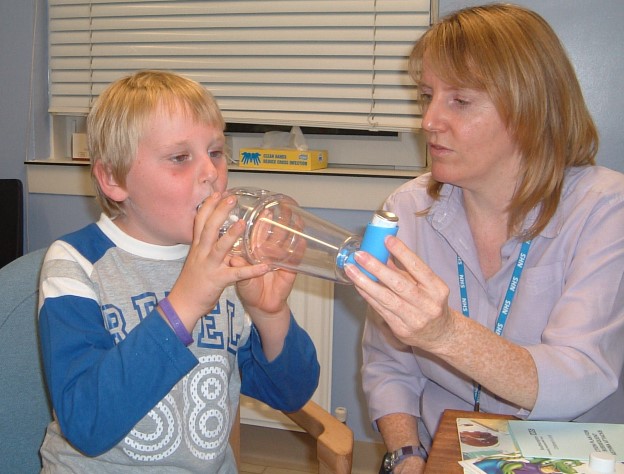
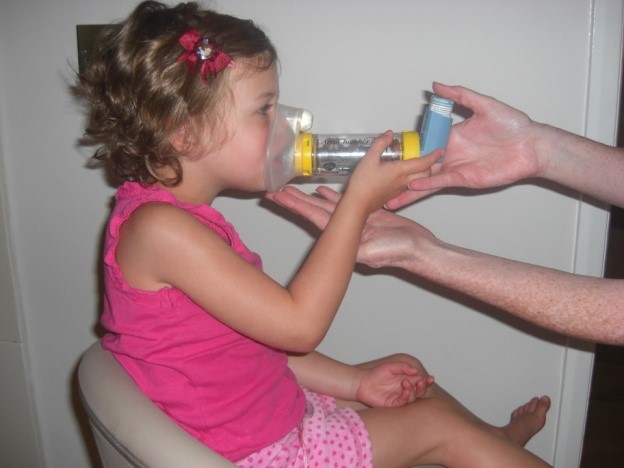
Choose appropriate sized spacer with mask (or mouthpiece if child is over 3 years with good technique and is not significantly short of breath).


  1. Shake the inhaler well and remove cap
  2. Fit the inhaler into the opening at the end of the spacer
  3. Place mask over the child’s face or mouthpiece in their mouth ensuring a good seal
  4. Press the inhaler once and allow the child to take slow breaths between each dose 
  5. Remove the inhaler and shake between every puff. Wait 1 minute between puffs

Repeat steps 1 – 5 for subsequent doses


Plastic spacers should be washed before 1st use and every month as per manufacturer’s guidelines

For videos on using your child’s inhaler and spacer correctly see goo.gl/235DQf

Over the next few days, your child will given a blue (salbutamol) reliever inhaler and you need to take 2-4 puffs of your reliever (1 puff at a time) every 4 hours using the spacer

  • Ensure your child always has access to their reliever (blue) inhaler and spacer
  • Start reliever treatment early at the start of a runny nose - 2 puffs 4 hourly
  • Remember to leave a spare reliever inhaler (with/without spacer) at school for your child and ensure that it is kept in date
  • Remember to take inhaler with you or your child on any trips away from home
  • Always use the correct inhaler device as prescribed for you or your child
  • Remember a spacer is the best way to deliver reliever treatment in an emergency
  • Remember to keep any follow up appointments and attend their annual asthma review at their general practice
  • If your child has been discharged from hospital following an exacerbation, you should arrange for them to be seen in the next 48 hours by the GP/Practice nurse
Feedback Question: Has the advice on this page helped you with a healthcare decision?

There are many sensory issues associated with sleep including:

  • Sensitivity to sound, touch, and visual stimuli which can be distracting and distressing and can affect the process of falling asleep.
  • Interoception difficulties, particularly recognising when hungry, full or thirsty or when the person is tired. 
  • Some children are more sensitive to foods like sugar, caffeine and additives which keep people awake.

Look at the bedroom environment to see what may be affecting their ability to go to sleep and stay asleep. Do their pyjamas and bedclothes feel comfortable, are they too hot or cold?  Is it too light or too dark, too noisy or too quiet? Perhaps it is too cluttered and stimulating. Think about your child’s diet. Are they eating too early or not having enough to eat? Are they eating food that can stimulate them close to bedtime. There can be added difficulties where children have restrictive diets but some simple adjustments of what is eaten and when can make a big difference. 

Click here for more information on sensory issues.
 

Sticking to the same routine helps your child to know what to expect at bedtime and helps them feel secure. It also helps to support your child’s internal body clock and keep it on track. The age related sleep advice and information on this website can help with establishing routines. Some children will benefit from using picture timetables, timers or social stories to help them understand their bed-time routine. More information about visual supports can be found on these websites

Visual Resources | Autism West Midlands 
Visual Supports | Autism Toolbox Autism Toolbox

Your child may be feeling overstimulated after a busy day and needs help to wind down, or their environment may be overstimulating with lots of toys, TVs and computers within reach. Avoiding TV and computers or hand-held devices an hour before bedtime can help your child to wind down. Activities that are good for the wind down period are jigsaws and colouring. Having a relaxing bath and milky drink can help some children, but for some children having a bath can over-excite them so they may need to have their bath earlier in the day.

Children who wake to use the toilet, wet the bed, or who wear nappies or pull-ups at night that need changing may have disturbed sleep. Eric, the children’s bowel and bladder charity are a good source of advice on this topic.


What might help 

Keeping a sleep diary 

A sleep diary can help you understand what may be causing difficulties with sleep. Fill it out every evening and record as much as you can. You can use it to spot patterns and make changes that may help. 

The Sleep Charity have templates you can download; one for teenagers and one for younger children. 

Seeking advice and help from sleep services 

There are organisations that can help you if you are having difficulties with your child’s sleep. There are many national organisations, including those who specialise in sleep for SEND families, and there are also community-based services in Shropshire, Telford and Wrekin. Click the link at the bottom of page to visit our support services page. 

Understanding sleep cycles 

The circadian sleep cycle is a 24-hour cycle that helps govern essential bodily functions especially the sleep-wake cycle. It plays a vital role in a person’s ability to sleep in one consolidated block of time at night and to stay awake during the day. As the sun sets in the evening, the brain begins producing melatonin, a hormone that induces sleepiness. Core body temperature also drops.

As melatonin and tryptophan (an amino acid which helps produce melatonin) are naturally produced in the body, there are things you can do to help their production.  Darkness helps to promote the production of melatonin which is why it is a good idea to put your child to sleep in a darkened room, and light emitting devices such as tablets and phones also can destroy Melatonin so should not be used for at least an hour before bed. New research shows that limiting exposure to screens and increasing physical activity levels during the day has a positive effect on children's overall physical, mental health and wellbeing, including sleep.

Setting a waking time consistently even in holiday times, called ‘anchoring’ the wake time, can help to reset the body clock over time. This should be accompanied with exposure to lots of light on waking to support circadian rhythm. 

Melatonin and tryptophan occur naturally in some foods and drinks such as milky drinks and cereals which is why having a milky drink before bed can help settling to sleep. For more information visit Diet & Sleep - The Sleep Charity

Prescriptions of melatonin

Behavioural strategies and practical solutions are the best way to address sleep difficulties, but if they are having a significant impact on your child’s ability to function, a drug form of melatonin is sometimes prescribed for neurodivergent children. As the drug’s function is to re-set sleep and wake cycles, it works best combined with good sleep hygiene practices. It is important that is it taken under medical supervision and not purchased on-line so that it is closely monitored for dosage and side effects. It should be prescribed for the shortest period necessary as the long-term effects of the drug on children’s development are not yet known. 
In Shropshire, Telford and Wrekin the Community Paediatric Service and the BeeU Service (CAMHS) can prescribe Melatonin for children and young people who meet ALL of the following criteria.

  1. the child/young person must be open to and being treated by the service due to a neurodevelopmental/mental health need (diagnosis not required)
  2. sleep issues are causing significant impact on the child/ young person, for example due to daytime sleeping or behavioural problems that are impacting daily functioning or educational attendance
  3. behavioural approaches have been tried and failed. These may have been offered by the service (where available) or by community sleep support services.

GPs are unable to prescribe Melatonin although they sometimes issue repeat prescriptions when prescribing has been started by a specialist (such as a paediatrician or child psychiatrist). 

Further support 

Click on the link below to visit a page with information about

  • national websites and sleep organisations
  • local community services in Shropshire, Telford and Wrekin.