



Earache (following remote assessment)

Advice for professionals

Advice for parents and carers after remote assessment for earache

Ear infections are extremely common in children. They are caused by either an infection of the middle ear that causes inflammation and a build-up of fluid (otitis media) or by an infection of the skin of the ear canal (otitis externa). Otitis externa is also known as ‘swimmers ear’ because it occurs more commonly when water enters the ear canal. Although most children with otitis media and otitis externa need no specific treatment, they will need to seen by a healthcare professional if they have pus coming out of their ear, in order to decide if treatment is required.

Symptoms of otitis media:

  • Earache

  • Fever may be present

  • Misery

  • Pulling, tugging or rubbing ear

  • Slight hearing loss

In most cases, the symptoms of otitis media develop quickly and get better by themselves in a few days. In some cases pus may run out of the ear, this is the fluid that had built up behind the ear drum causing a small hole in the eardrum; this tends to heal up by itself.

Symptoms of otitis externa:

  • Pain and tenderness in the ear canal

  • Itchiness

  • Foul smelling yellow or green pus in the ear canal

  • Fever

  • Reduced hearing

  • Noises inside the ear, such as buzzing, humming or ringing (tinnitus)

  • Otitis externa is usually one sided (unilateral)

When should you worry?

If your child has any of the following:

  • Is going blue around the lips
  • Has pauses in their breathing (apnoeas) or has an irregular breathing pattern
  • Too breathless to talk / eat or drink
  • Becomes pale, mottled and feel abnormally cold to touch
  • Has a fit / seizure
  • Becomes extremely agitated (crying inconsolably despite distraction), confused or very lethargic (difficult to wake)
  • Develops a rash that does not disappear with pressure (the 'Glass Test')
  • Is under 3 months of age with a temperature of 38°C / 100.4°F or above (unless fever in the 48 hours following vaccinations and no other red or amber features) 

You need urgent help

Go to the nearest Hospital Emergency (A&E) Department or phone 999

If your child has any of the following:

  • Has pus coming out of the ear
  • Develops swelling behind the ear or increasing pain / redness behind the ear
  • Develops dizziness or is losing their balance
  • Is becoming drowsy (excessively sleepy) or irritable (unable to settle them with toys, TV, food or picking up) - especially if they remain drowsy or irritable despite their fever coming down
  • Is complaining of a severe headache and neck stiffness/pain or discomfort with bright lights (photophobia)
  • Is having breathing problems, such as rapid, shortness of breath or laboured breathing (drawing in of muscles below the lower ribs when they breath in)
  • Seems dehydrated (sunken eyes, drowsy or no urine passed for 12 hours)
  • Has extreme shivering or complains of muscle pain
  • Is 3-6 months of age with a temperature of 39°C / 102.2°F or above (but fever is common in babies up to 2 days after they receive vaccinations)
  • Continues to have a fever of 38.0°C or above for more than 5 days
  • Is getting worse or if you are worried

You need to contact a doctor or nurse today

Please ring your GP surgery or contact NHS 111 - dial 111 or for children aged 5 years and above visit 111.nhs.uk

If none of the above features are present

Self care

Continue providing your child’s care at home. If you are still concerned about your child, contact NHS 111 – dial 111 or for children aged 5 years and above visit 111.nhs.uk

This content has been developed by healthcare professionals from across the UK in collaboration with the RCPCH.

Treatment

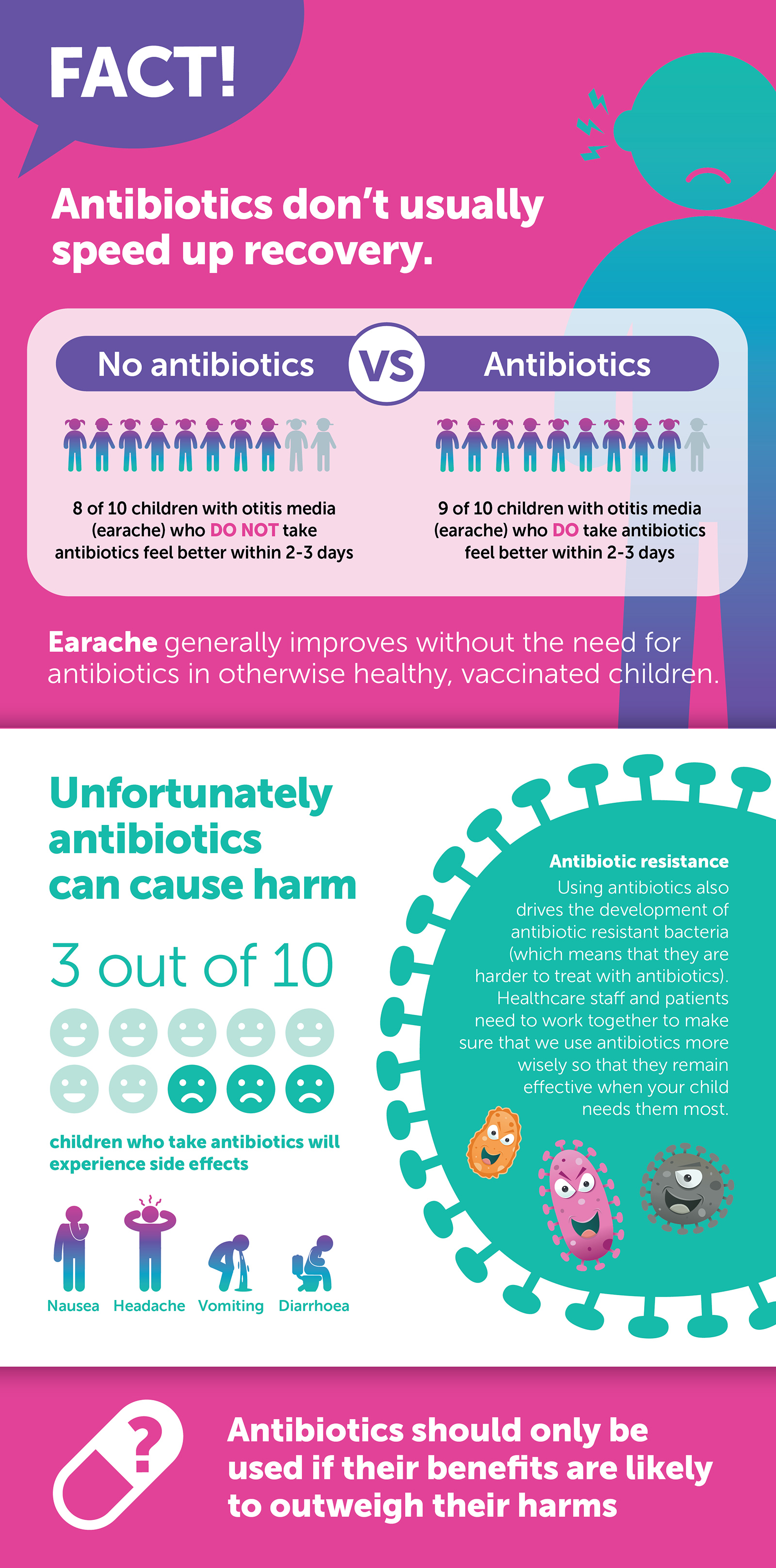
Most children with earache do not require treatment with antibiotics. Antibiotics rarely speed up recovery and often cause side effects such as rash and diarrhoea. They will also promote the development of antibiotic resistant bacteria in your child.
Antibiotics are usually only considered if your child:

  • Is under 6 months of age and has otitis media (a middle ear infection)
  • Is between 6 months and 2 years of age with infection in both ears, or with associated symptoms such as altered sleep, fever and overwhelming misery
  • Has pus draining from their ear
  • Has a serious health condition that makes them more vulnerable to serious infection

If your child has any features of severe infection (amber or red features above), they will need to be urgently assessed by a healthcare professional

You can help relieve symptoms by:

  • Giving your child paracetamol or ibuprofen to help relieve pain
  • Encouraging your child to drink plenty of fluids
  • Give calpol if necessary

Prevention

It is not possible to prevent ear infections; however, you can do things that may reduce your child’s chances of developing the condition.

  • Avoid cleaning your child’s ears with cotton buds – this may damage and irritate the ear canal and pushes wax further into the ear. Wax is designed to come out by itself
  • Try not to let soap or shampoo get into your child’s ear canal
  • Try to keep your child’s ears dry; if water gets in, tip it out as soon as possible. However, this can be extremely challenging in young children!
  • Ensure your child is up-to-date with their immunisations
  • Avoid exposing your child to smoky environments (passive smoking)
Feedback Question: Has the advice on this page helped you with a healthcare decision?

There are many sensory issues associated with sleep including:

  • Sensitivity to sound, touch, and visual stimuli which can be distracting and distressing and can affect the process of falling asleep.
  • Interoception difficulties, particularly recognising when hungry, full or thirsty or when the person is tired. 
  • Some children are more sensitive to foods like sugar, caffeine and additives which keep people awake.

Look at the bedroom environment to see what may be affecting their ability to go to sleep and stay asleep. Do their pyjamas and bedclothes feel comfortable, are they too hot or cold?  Is it too light or too dark, too noisy or too quiet? Perhaps it is too cluttered and stimulating. Think about your child’s diet. Are they eating too early or not having enough to eat? Are they eating food that can stimulate them close to bedtime. There can be added difficulties where children have restrictive diets but some simple adjustments of what is eaten and when can make a big difference. 

Click here for more information on sensory issues.
 

Sticking to the same routine helps your child to know what to expect at bedtime and helps them feel secure. It also helps to support your child’s internal body clock and keep it on track. The age related sleep advice and information on this website can help with establishing routines. Some children will benefit from using picture timetables, timers or social stories to help them understand their bed-time routine. More information about visual supports can be found on these websites

Visual Resources | Autism West Midlands 
Visual Supports | Autism Toolbox Autism Toolbox

Your child may be feeling overstimulated after a busy day and needs help to wind down, or their environment may be overstimulating with lots of toys, TVs and computers within reach. Avoiding TV and computers or hand-held devices an hour before bedtime can help your child to wind down. Activities that are good for the wind down period are jigsaws and colouring. Having a relaxing bath and milky drink can help some children, but for some children having a bath can over-excite them so they may need to have their bath earlier in the day.

Children who wake to use the toilet, wet the bed, or who wear nappies or pull-ups at night that need changing may have disturbed sleep. Eric, the children’s bowel and bladder charity are a good source of advice on this topic.


What might help 

Keeping a sleep diary 

A sleep diary can help you understand what may be causing difficulties with sleep. Fill it out every evening and record as much as you can. You can use it to spot patterns and make changes that may help. 

The Sleep Charity have templates you can download; one for teenagers and one for younger children. 

Seeking advice and help from sleep services 

There are organisations that can help you if you are having difficulties with your child’s sleep. There are many national organisations, including those who specialise in sleep for SEND families, and there are also community-based services in Shropshire, Telford and Wrekin. Click the link at the bottom of page to visit our support services page. 

Understanding sleep cycles 

The circadian sleep cycle is a 24-hour cycle that helps govern essential bodily functions especially the sleep-wake cycle. It plays a vital role in a person’s ability to sleep in one consolidated block of time at night and to stay awake during the day. As the sun sets in the evening, the brain begins producing melatonin, a hormone that induces sleepiness. Core body temperature also drops.

As melatonin and tryptophan (an amino acid which helps produce melatonin) are naturally produced in the body, there are things you can do to help their production.  Darkness helps to promote the production of melatonin which is why it is a good idea to put your child to sleep in a darkened room, and light emitting devices such as tablets and phones also can destroy Melatonin so should not be used for at least an hour before bed. New research shows that limiting exposure to screens and increasing physical activity levels during the day has a positive effect on children's overall physical, mental health and wellbeing, including sleep.

Setting a waking time consistently even in holiday times, called ‘anchoring’ the wake time, can help to reset the body clock over time. This should be accompanied with exposure to lots of light on waking to support circadian rhythm. 

Melatonin and tryptophan occur naturally in some foods and drinks such as milky drinks and cereals which is why having a milky drink before bed can help settling to sleep. For more information visit Diet & Sleep - The Sleep Charity

Prescriptions of melatonin

Behavioural strategies and practical solutions are the best way to address sleep difficulties, but if they are having a significant impact on your child’s ability to function, a drug form of melatonin is sometimes prescribed for neurodivergent children. As the drug’s function is to re-set sleep and wake cycles, it works best combined with good sleep hygiene practices. It is important that is it taken under medical supervision and not purchased on-line so that it is closely monitored for dosage and side effects. It should be prescribed for the shortest period necessary as the long-term effects of the drug on children’s development are not yet known. 
In Shropshire, Telford and Wrekin the Community Paediatric Service and the BeeU Service (CAMHS) can prescribe Melatonin for children and young people who meet ALL of the following criteria.

  1. the child/young person must be open to and being treated by the service due to a neurodevelopmental/mental health need (diagnosis not required)
  2. sleep issues are causing significant impact on the child/ young person, for example due to daytime sleeping or behavioural problems that are impacting daily functioning or educational attendance
  3. behavioural approaches have been tried and failed. These may have been offered by the service (where available) or by community sleep support services.

GPs are unable to prescribe Melatonin although they sometimes issue repeat prescriptions when prescribing has been started by a specialist (such as a paediatrician or child psychiatrist). 

Further support 

Click on the link below to visit a page with information about

  • national websites and sleep organisations
  • local community services in Shropshire, Telford and Wrekin.